Trains to Amsterdam from London, Paris and Brussels
Three capital cities sit within a comfortable rail ride of Amsterdam, and the city's main station drops you inside the canal ring. Here is how the routes work, what to book ahead, and how to reach the centre the moment you step off the train.
Short answer
Direct and one-change trains connect Amsterdam with London, Paris and Brussels, all arriving at Amsterdam Centraal in the heart of the canal ring. From Schiphol the NS train costs from €5.50 and takes just over 17 minutes. A GVB 24-hour travel card costs €10.00, and the big museums require pre-booked timed entry.
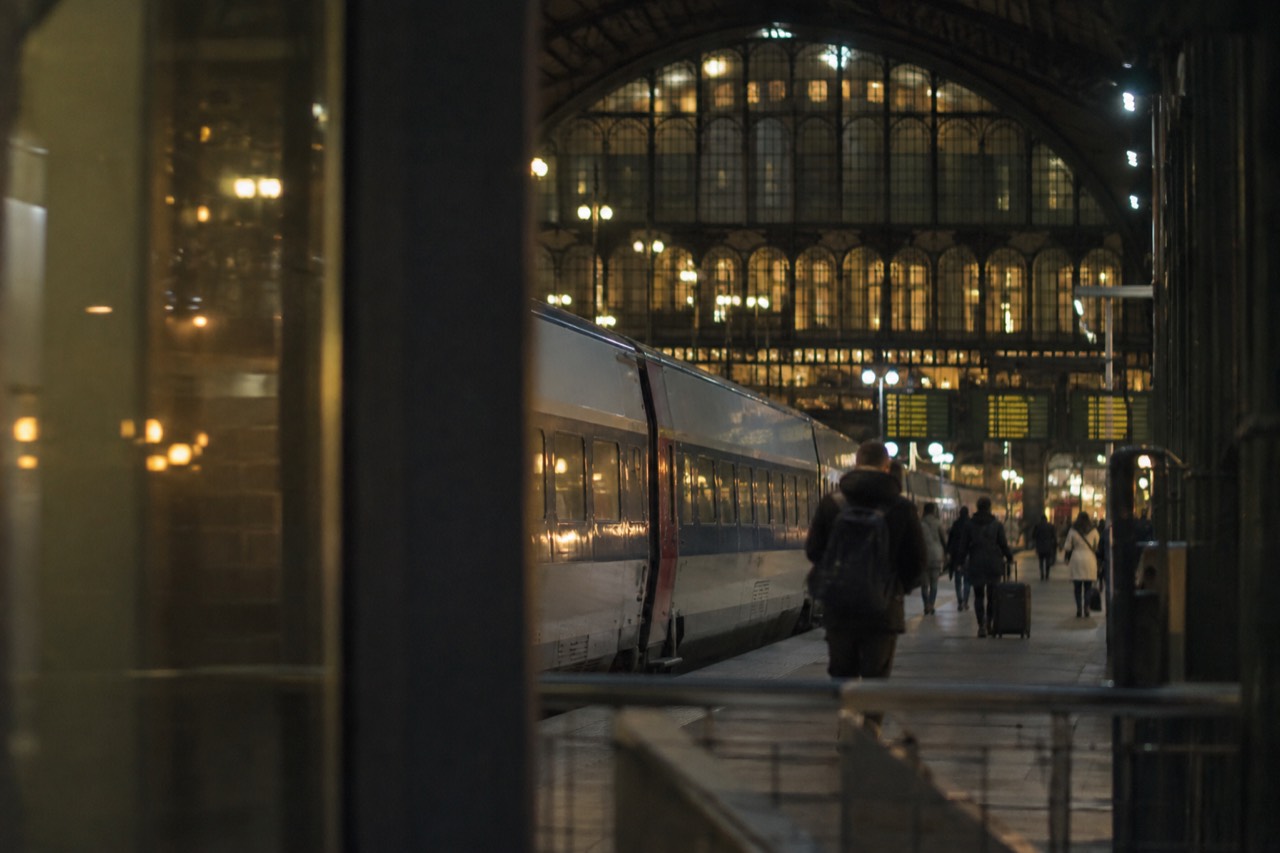
Amsterdam Centraal sits at the northern edge of the canal ring, which means a rail arrival puts you closer to the Jordaan, the Red Light District and Dam Square than almost any hotel shuttle could. The station handles international services, domestic trains from Schiphol and the regional network, and its forecourt feeds directly into the tram system. That single fact shapes the whole case for arriving by rail: the last kilometre of your journey is a tram ride, not a transfer.
The city recorded 23.7 million tourist overnight stays in 2025, and the municipal research service forecasts between 23.7 and 25.1 million for 2026, so the pressures that make flying awkward, crowded airports and long surface transfers, apply to the railways too. The difference is where the crowding ends. A train deposits you at the edge of everything you came to see.
What Is the Train from London to Amsterdam Like?
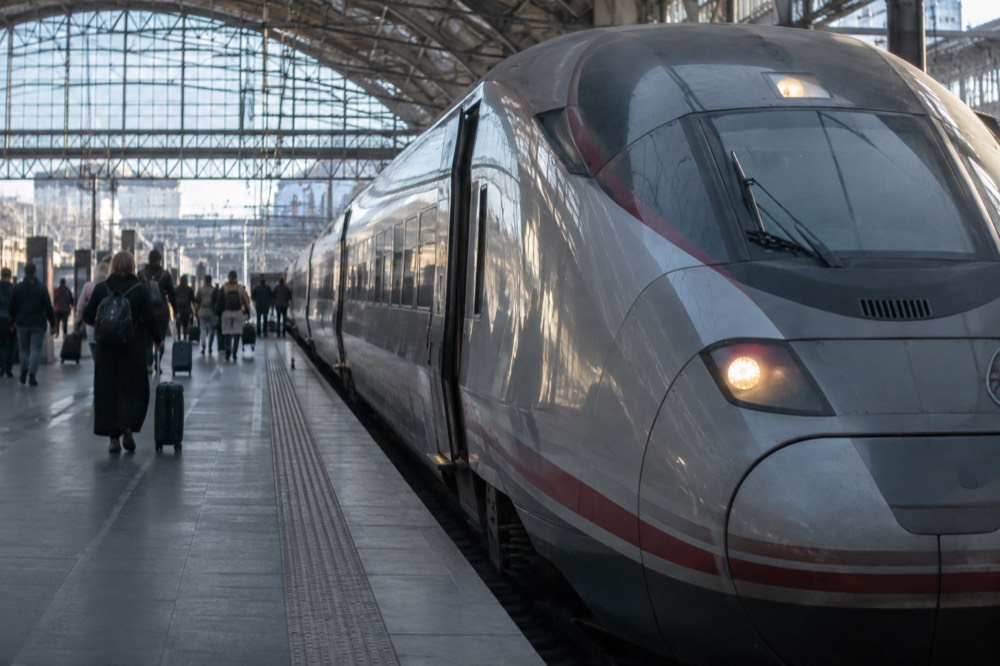
The London route is a high-speed service departing from St Pancras International and crossing to the continent through the Channel Tunnel, with some journeys running direct to Amsterdam Centraal and others involving a change. Ticket and passport checks happen before boarding in London, so arrival in the Netherlands is a walk off the train rather than a queue. Journey times and frequencies are published on the operator's own timetable.
The practical appeal is the city-centre to city-centre nature of the trip. St Pancras and Amsterdam Centraal are both destinations in themselves, not satellite airports an hour from anything. You also carry a luggage allowance closer to an airline's than a budget bus's, and the seating is built for working or sleeping rather than enduring.
Booking behaves much like aviation: fares rise as the travel date approaches and the cheapest tickets carry the least flexibility. The operator's own website is the place to compare dates, since prices move and no third-party figure stays honest for long. Weekend and holiday departures fill first, and the direct services are the first to sell out, so if your dates are fixed, book when bookings open rather than when the mood takes you.
One planning note that catches people out: the return leg from Amsterdam has historically involved a security and border process at the station, and the operator advises arriving well before departure. Check the current advice on the operator's page when you book, because procedures have changed more than once and the station's layout does not make an early arrival unpleasant. There is coffee, and there is a canal across the road.
How Do the Paris and Brussels Routes Compare?
Paris and Brussels both feed high-speed international services into Amsterdam, and Brussels is the shorter hop, which also makes it the common change point for travellers arriving from London on connecting journeys. Both routes terminate at Amsterdam Centraal. Fares follow the same logic as the London service: book early on the operator's own site, and treat any third-party price as a snapshot rather than a promise.
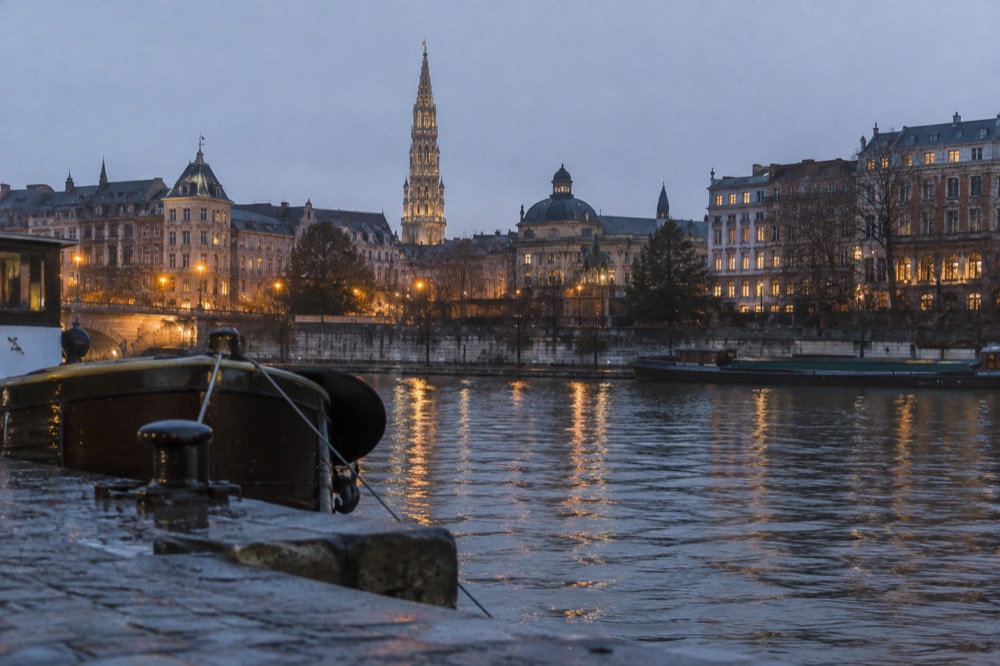
The Brussels route in particular doubles as a useful staging option. Belgium's capital is close enough that a morning train gets you to Amsterdam before the museum queues build, and the frequency on the corridor means a missed connection is an inconvenience rather than a lost day. Travellers combining cities often ride Brussels first, spend a night, then continue north; our Brussels day trip guide covers what is worth the stop.
Paris is the longer ride but a straightforward one, and it pairs naturally with a Dutch capital visit because the two cities complement rather than resemble each other. If you are planning the reverse direction or weighing the pairing in detail, the Paris by train from Amsterdam guide breaks down the route, the booking windows and the trade-offs against flying.
| Route | Arrival station | Typical booking approach | Best for |
|---|---|---|---|
| London to Amsterdam | Amsterdam Centraal | Book direct on the operator's site as early as dates allow | City-centre to city-centre travel without airports |
| Paris to Amsterdam | Amsterdam Centraal | Book direct; compare direct services against one-change options | Combining two capitals in one trip |
| Brussels to Amsterdam | Amsterdam Centraal | Book direct; high frequency makes last-minute changes manageable | Short hops and onward connections |
Whichever corridor you ride, the arrival experience is identical: you step into a station hall with a tram stop outside the main entrance, a bus station beside it, and the old centre a ten-minute walk straight ahead. There is no airport-style transfer to budget for, which is the quiet advantage of every route in this table.
Once the train part is settled, the question becomes what to do with a first afternoon, and the honest answer is that a canal cruise is the standard opening move. It orients you faster than any map.
Where Do the Trains Arrive and How Do You Reach the Centre?
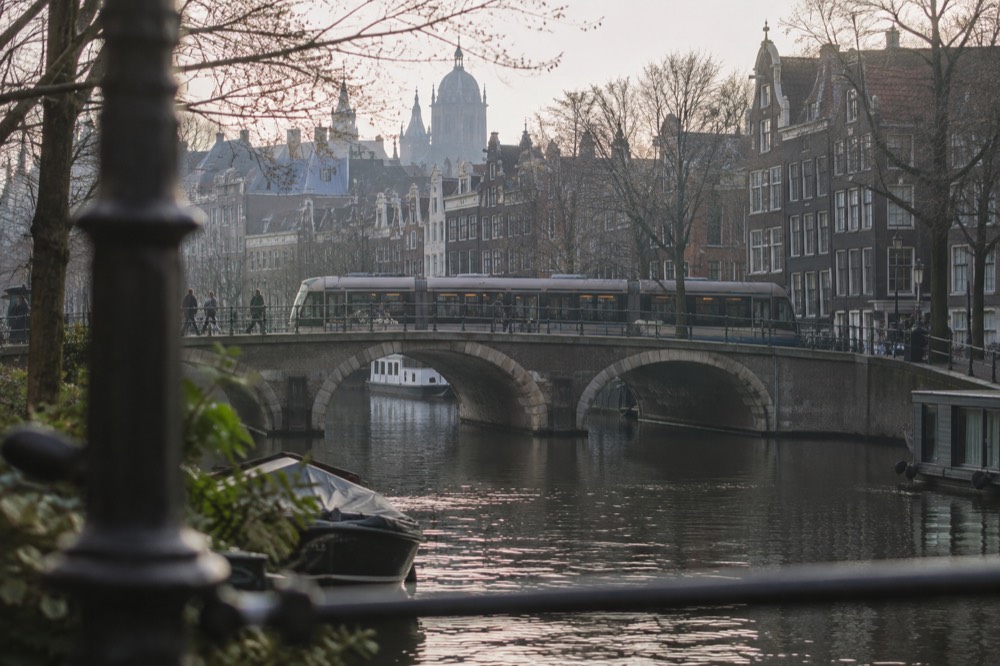
Every international service from London, Paris and Brussels arrives at Amsterdam Centraal, which faces the Damrak and stands roughly a ten-minute walk from Dam Square at the heart of the old centre. The tram and bus stops sit directly outside the main entrance, metro platforms sit beneath the station, and the free GVB ferries to Amsterdam Noord leave from the rear. You rarely need more than one ticket to finish the journey.
The tram network is the workhorse. A one-hour GVB ticket costs €3.40, and a 24-hour card costs €10.00 for adults and €5.00 for children, per the operator's published fare table at GVB prices. Multi-day cards step up from there: €16.00 for 48 hours, €21.50 for 72 hours, €27.50 for 96 hours, €34.00 for 120 hours, €39.00 for 144 hours and €43.00 for a full week. If you plan to ride trams three or more times a day, the day cards win quickly.
Contactless payment works too. OVpay lets you tap a bank card or phone on GVB trams, buses, metro and ferries, charging a base fare of €1.16 plus €0.217 per kilometre with a daily cap on the GVB network. For a visitor making a handful of short rides it removes the ticket-machine queue entirely. The full picture, including the metro lines and the ferries, is in our getting around Amsterdam guide.
| GVB ticket | Price | Notes |
|---|---|---|
| 1-hour ticket | €3.40 | Single journey within the hour |
| 24-hour card, adult | €10.00 | Unlimited GVB rides for a day |
| 24-hour card, child | €5.00 | Same validity, child rate |
| 48-hour card | €16.00 | Two full days of tram, bus and metro |
| 72-hour card | €21.50 | Suits a long weekend |
| 120-hour card | €34.00 | Covers a five-day stay |
If your train actually terminates at Schiphol because of engineering works or a routing quirk, the fix is simple: the NS train from Schiphol to Amsterdam Centraal runs from €5.50 and takes just over 17 minutes, according to the rail operator's own route page at NS Schiphol to Amsterdam. The airport's own transfer details, including the bus alternative, are covered in our Schiphol to central Amsterdam guide.
Do You Need to Book Amsterdam Attractions Before You Travel?
Yes, for the headline sights. The Van Gogh Museum requires every visitor to pre-book a timed entry ticket, the Rijksmuseum requires a booked start time even for pass holders, and the Anne Frank House sells tickets only through its own website for a specific date and time, with no door sales at all. A rail traveller with fixed arrival dates should treat these bookings as part of the journey plan, not something to sort out at the hotel.
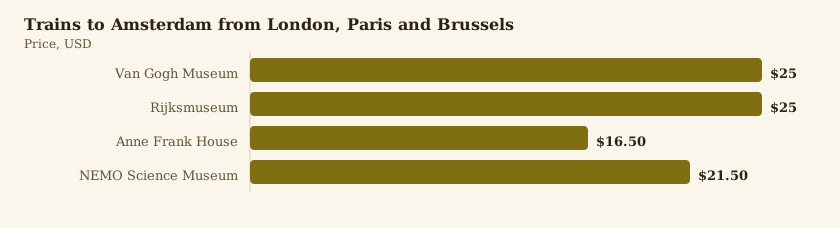
The Van Gogh Museum is the clearest case. Adult admission is €25, visitors under 18 enter free, and the museum's own visit page states that all visitors are required to pre-book a timed entry ticket, with slots selling out. The museum opens daily from 9am to 6pm and stays open until 9pm on Fridays, with a few published exceptions. A skip-the-queue ticket product is listed at $31.00 from on the live listing, rated 4.7 across 57,096 reviews, and it exists precisely because timed slots vanish: Van Gogh Museum ticket, with Check availability showing live slot options.
The Anne Frank House is stricter still. Adult tickets cost €16.50 including the booking fee, ages 10 to 17 pay €7.00 and ages 0 to 9 pay €1.00, and the museum's own ticket page is the only sales channel: the I amsterdam City Card gets no discount there, and a Museumkaart covers only the €1.00 booking fee. Tickets are released for visits weeks ahead and sell out quickly, and they are non-refundable and non-transferable, so anchor the rest of your itinerary around whatever slot you actually secure. The wider set of guides lives on Things to Do in Amsterdam.
| Attraction | Adult price | Booking rule |
|---|---|---|
| Van Gogh Museum | €25 | Timed entry ticket required for all visitors |
| Rijksmuseum | €25 | Start time must be booked; free for ages 18 and under |
| Anne Frank House | €16.50 | Online only, specific time slot, no door sales |
| NEMO Science Museum | €21.50 | Flat price for everyone aged 4 and over; tickets carry a start time |
Is Arriving by Train Better Than Flying?
For city-centre destinations, the train usually wins on the last mile rather than the first: Schiphol is efficient, but Centraal station is already inside the place you came to see, so the transfer drops from a tram or taxi ride to a walk. Cost depends on how early you book either mode, and both rail fares and flights rise steeply near the travel date, so the early booker wins whichever vehicle they choose.
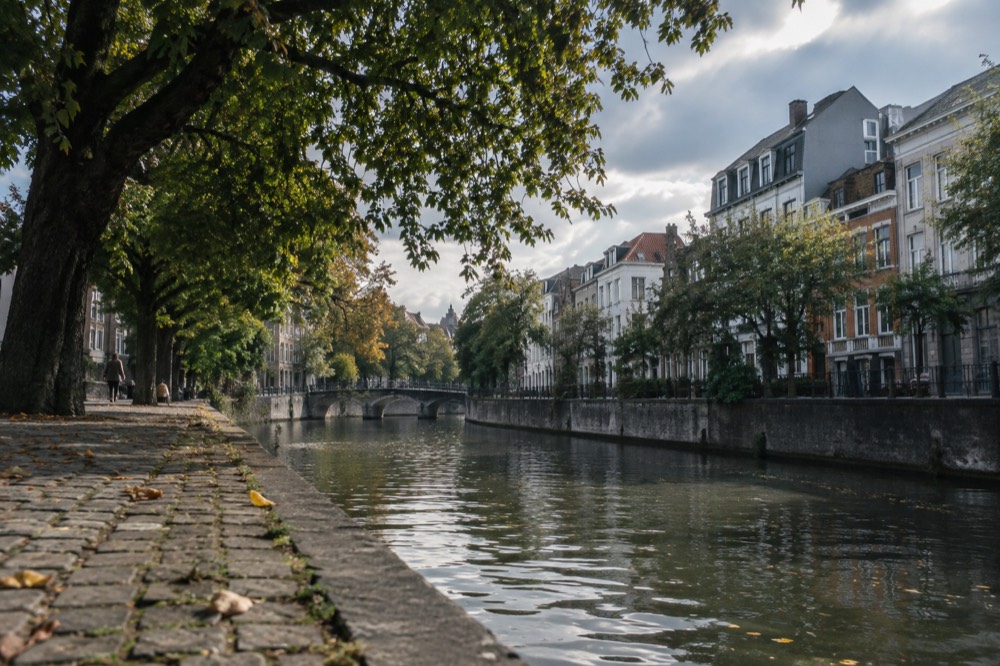
The intangibles favour rail for short trips. A weekend visitor loses most of a Friday evening to an airport and recovers it on a train, where the journey itself is usable time. Luggage rules are simpler, the seat is larger, and the arrival puts you within a ten-minute walk of Dam Square. For a trip of three days or fewer, the arithmetic of transfer time matters more than headline speed.
Flying still makes sense from further afield or when rail fares have spiked, and Schiphol is a genuinely easy airport to land at, with the station directly under the terminals. The comparison that matters is not train versus plane in the abstract but door-to-door time on your specific dates, including the transfer at each end. For London, Paris and Brussels departures, the rail corridors are competitive enough that the decision usually comes down to price on the day you book.
One warning worth carrying through: do not let the arrival-day plan depend on a walk-up museum ticket. The sights in the table above are the ones that fill, and a delayed train plus a sold-out Van Gogh slot is a self-inflicted wound. Book the timed entries when you book the train, and treat the rest of the city as flexible.
What Should Your First Day in Amsterdam Look Like?
Most rail arrivals land before noon, which leaves an afternoon. The pattern that works is a canal cruise first to orient yourself, one timed museum slot in the mid-afternoon, and the evening in the centre near your hotel, with everything reachable by tram or on foot from Centraal. Book the museum slot before you travel, leave the cruise to whichever departure point is closest to where you are standing, and keep the first day deliberately light.
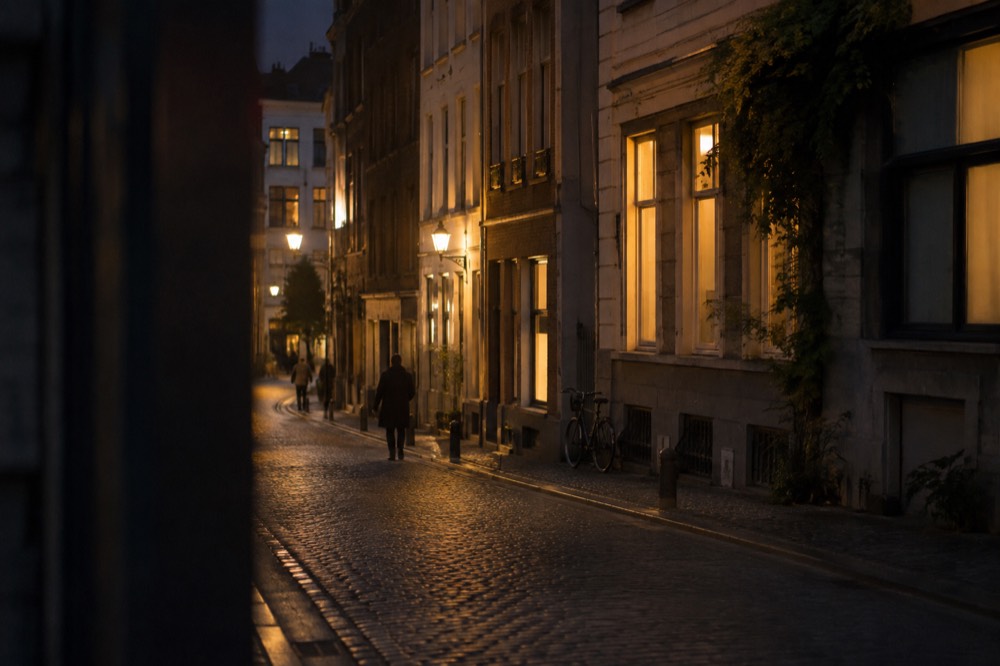
The cruise is the orientation tool. A one-hour loop past the gabled houses and under the bridges teaches the geography faster than any guidebook chapter, and departures cluster around the centre. The classic saloon boat option, a wooden vessel from the late nineteenth century with a live guide, is listed at $19.56 from and rated 4.8 across 33,435 reviews on the live listing; the roster also carries a drinks-and-cheese variant at $16.00 from rated 4.6 across 31,369 reviews if you want the version with a glass in hand.
For the museum slot, pick one, not three. The Van Gogh Museum and the Rijksmuseum sit facing each other across Museumplein, so a single well-timed ticket plus a stroll through the square is a full and satisfying afternoon; attempting both plus a cruise in one arrival day is how people end up remembering nothing. The Rijksmuseum guide covers what to see if that is the one you choose.
Evening options are where the city earns its reputation, and they need no booking at all: the brown cafés of the Jordaan, the lit-up canal ring, and a slow walk back toward Centraal. If beer is your subject, the Heineken Experience in the original brewery building runs 90-minute visits listed at $23.00 from and rated 4.6 across 39,581 reviews, and it sits close enough to the museum quarter to tag onto an afternoon.
The broader point for rail travellers is that everything on this list sits inside the area a Centraal arrival makes walkable. You never need a car, you rarely need more than a day travel card, and the only deadlines that matter are the timed-entry slots you booked before you left home. That is the quiet argument for the train: it does not just bring you to Amsterdam, it delivers you into the middle of it, with the whole toolkit of the city, trams, ferries, cruises and cobbled streets, already within reach of the platform.
Common Questions About Trains to Amsterdam
How long does the train from London to Amsterdam take?
Journey times vary by service, with some departures running direct and others involving a change, and the operator's own timetable is the only current source. What is fixed is the arrival point: every service terminates at Amsterdam Centraal, so the journey ends inside the canal ring rather than at an airport transfer.
Do I need a passport to travel by train from London to Amsterdam?
Yes. The London route crosses an external border of the Schengen area, so passport and security checks apply. They are carried out at the departure station in London, which is why the operator advises arriving well before departure; check the current advice when booking.
Where do trains from Paris and Brussels arrive in Amsterdam?
At Amsterdam Centraal, the main station facing the Damrak. Tram stops, bus stands and metro platforms sit at or beneath the station, and the free GVB ferries to Amsterdam Noord leave from the rear, so the transfer to any central neighbourhood is short.
How do I get from Amsterdam Centraal to my hotel?
Walk if the hotel is in the centre, or ride a tram using a €3.40 one-hour ticket, a €10.00 24-hour card, or an OVpay contactless tap with a daily cap on the GVB network. Most central hotels sit within two tram stops or a fifteen-minute walk of the station.
Should I book Amsterdam museum tickets before my train journey?
Yes. The Van Gogh Museum requires a timed entry ticket for every visitor, the Rijksmuseum requires a booked start time, and the Anne Frank House sells only through its own website for a specific slot with no door sales. Book these when you book the train.
Is it cheaper to fly or take the train to Amsterdam?
It depends entirely on when you book. Both rail fares and flights rise steeply close to the travel date, and the cheapest tickets in either mode are the least flexible. Compare door-to-door time and price on your actual dates before deciding.