Where Is The Best Place To See The Tulip Fields Near Amsterdam?
The best place to see tulip fields near Amsterdam is the Bollenstreek, the flower strip around Lisse, anchored by Keukenhof. Here is where to go, when to go and how to get there.
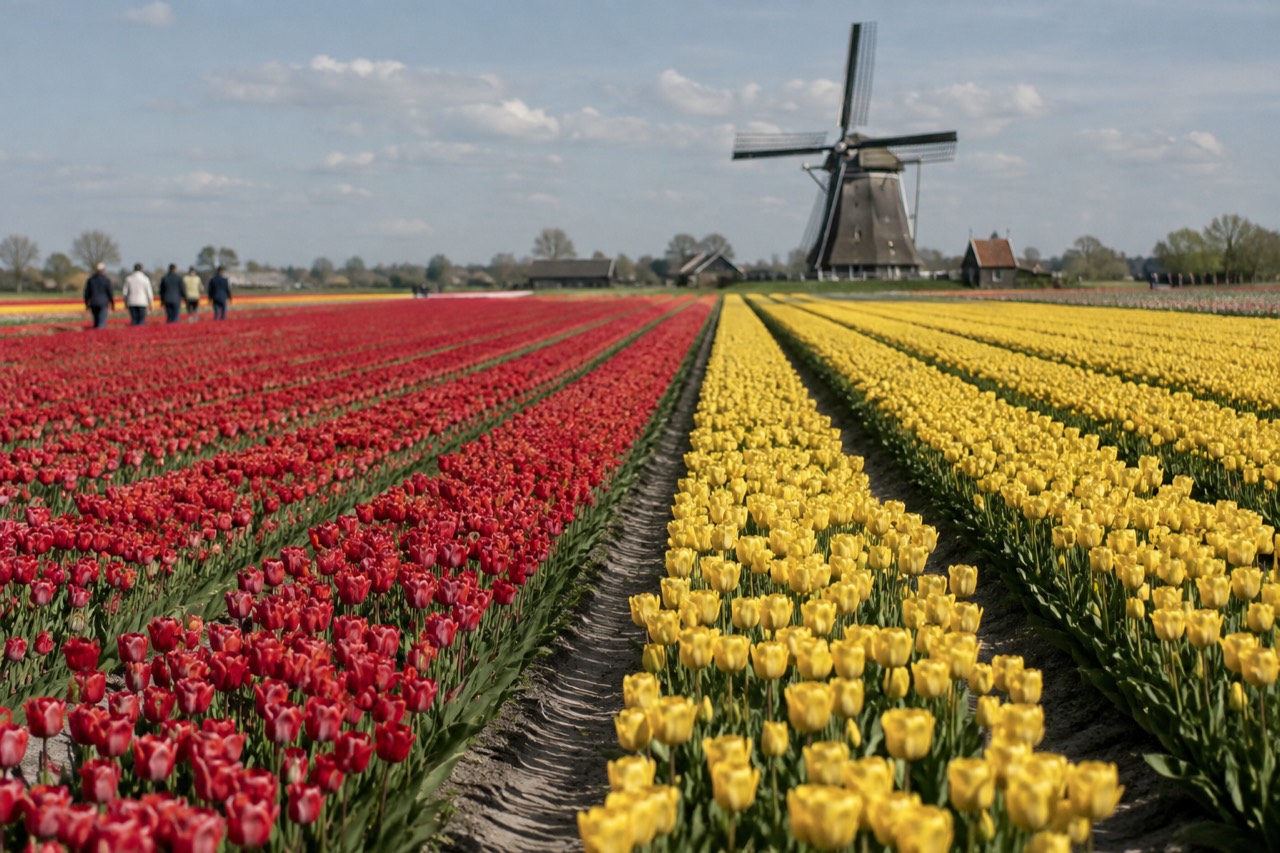
The postcard tulip fields you have seen in photographs are real, but almost none of them are in Amsterdam. The city has its tulip museum, its floating flower market and its beds in the Vondelpark, but the striped carpets of colour stretching to the horizon sit in the Bollenstreek, the bulb-growing region that runs from Haarlem in the north to Leiden in the south, with the village of Lisse at its heart. That is where Keukenhof sits too, the world-famous spring garden that opens for roughly eight weeks a year and nothing more.
Getting the geography right is the difference between a good tulip day and a wasted one. This guide covers where the fields actually are, when the bloom peaks, how Keukenhof differs from the open fields, and what your realistic options are if you cannot leave the city at all.
Where Is The Best Place To See The Tulip Fields?
The single best place to see tulip fields near Amsterdam is the Bollenstreek, the flower strip between Haarlem and Leiden, with Lisse as the anchor village. Keukenhof, the great spring garden, sits inside that strip and opens 18 March to 9 May 2027, daily from 08:00 to 19:00. The open farm fields around it peak later, roughly mid-April to early May, and cost nothing to look at.
The Bollenstreek, sometimes called the Bulb Region or Duin en Bollenstreek, is a narrow band of sandy soil behind the coastal dunes, roughly 30 to 40 minutes from Amsterdam by car or public transport. Growers have worked it since the tulip trade collapsed in the 17th century and farming bulbs became more profitable than speculating in them. Today the strip produces a large share of the world's export tulips, and for about six weeks each spring it does the most photogenic thing in Dutch agriculture.
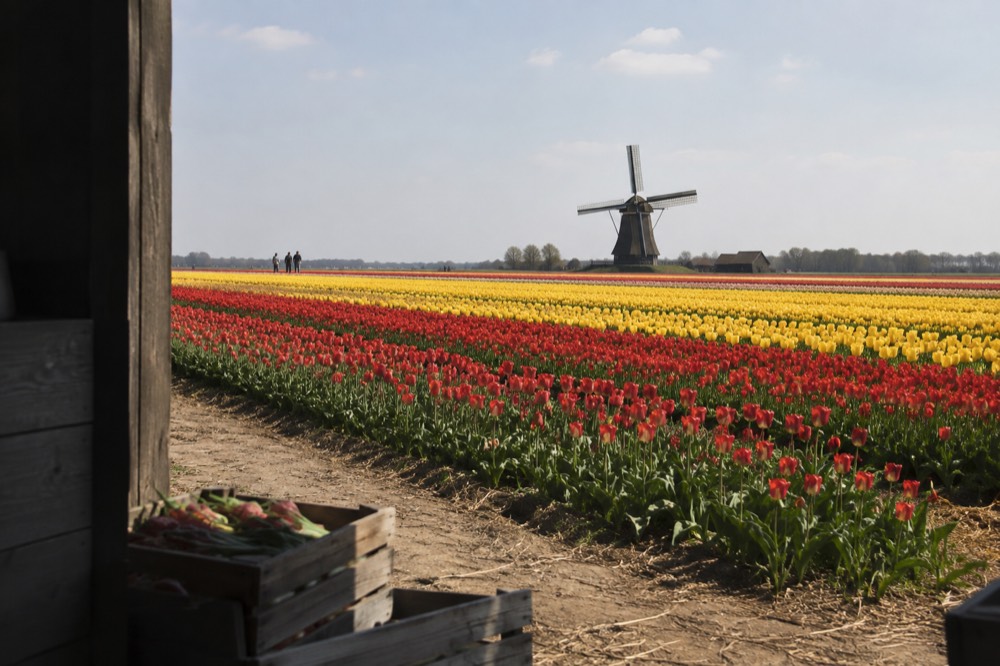
Within the strip, a few spots come up again and again. Lisse and the fields directly around Keukenhof are the classic choice, because you can combine a garden visit with a walk or cycle past the surrounding commercial fields. The area around Hillegom and Bennebroek to the north is quieter and just as colourful. Further south, near Noordwijk and Sassenheim, the fields run right up against the dune edge, which gives you the unusual backdrop of flower rows against green hills rather than flat horizon. Our full guide to tulip fields at Lisse and the Bollenstreek covers individual fields and viewing spots in more depth.
The honest summary: there is no single "secret field" that locals guard. There is a whole region that turns striped for a few weeks, and any road through it in late April will show you the spectacle. What you need to plan is the timing, not a hidden coordinate.
When Do the Tulip Fields Actually Bloom?
The Keukenhof garden season runs 18 March to 9 May 2027, but the open fields peak later, roughly mid-April to early May, and the exact week shifts with the weather every year. Hyacinths and daffodils flower first, tulips fill the middle of the window, and by mid-May the growers start cutting the heads off, because the fields exist to produce bulbs, not flowers.
The sequence matters more than most guides admit. Early in the season, from mid-March, the strip is dominated by daffodils and hyacinths, which are spectacular in their own right but are not the red-and-yellow tulip carpet of the postcards. Tulips take over from around the second or third week of April in a normal year. The last two weeks of April and the first days of May are the sweet spot where the widest range of varieties is in colour at once.
There is a hard ceiling on the season that no weather can move. Commercial tulip fields are grown for their bulbs, and once the flower has done its work the growers top the plants, cutting the flower heads off so the plant's energy goes back into the bulb underground. A field that was a solid sheet of red on 1 May can be a field of bare green stems a week later. This is why "I visited in mid-May and the tulips were gone" is the most common tulip-trip complaint, and it is not bad luck, it is agriculture.
Keukenhof's own published season for 2027 is Thursday 18 March to Sunday 9 May, daily from 08:00 to 19:00, as stated on the garden's official site (Keukenhof opening dates). The garden plants around seven million bulbs in layers so that something is always in flower across the whole eight weeks, which is exactly why it can open in mid-March while the open fields cannot. Ticket prices for 2027 were not yet on sale at the time of the site's research, so check the official channel before budgeting, and never trust a blog that quotes you a 2027 price today.
| Period | What Is in Colour | Best For |
|---|---|---|
| Mid-March to early April | Daffodils, crocuses, early hyacinths | Keukenhof's indoor shows and early beds |
| Early to mid-April | Hyacinths peak, first tulip rows open | Keukenhof, fewer crowds than Easter |
| Mid-April to early May | Tulips at full field peak | The open Bollenstreek fields, cycling routes |
| Early to mid-May | Late tulips, then topping begins | Last-chance visits, Keukenhof's final week |
If your dates are fixed and you land in the first half of March, plan around Keukenhof and the city's indoor flower culture rather than expecting open fields. If you can travel in late April, you get the full show. Our best time to visit Amsterdam guide puts the tulip window in the context of the rest of the year.
Keukenhof or the Open Fields: Which Should You Choose?
Keukenhof is a designed garden with about seven million bulbs, timed tickets and paved paths; the open fields are working farmland, free to view, at their best for roughly two weeks. Keukenhof guarantees colour across its whole 18 March to 9 May season, while the fields only guarantee it in late April. If you are visiting in early or mid-April, choose Keukenhof; in late April, do the fields and add the garden if you have time.
The two experiences are more different than they look from Amsterdam. Keukenhof is horticulture as theatre: themed gardens, rivers of blue muscari, orchid halls, and tulip varieties bred for show. It is extraordinary, and it is also crowded, with the narrow paths around the windmill and the tulip river reaching shoulder-to-shoulder on sunny weekends. The open fields are the opposite: no fences, no entry fee, no facilities, and a scale that no garden can imitate. Standing at the edge of a field with colour running to the treeline is the image people actually remember.
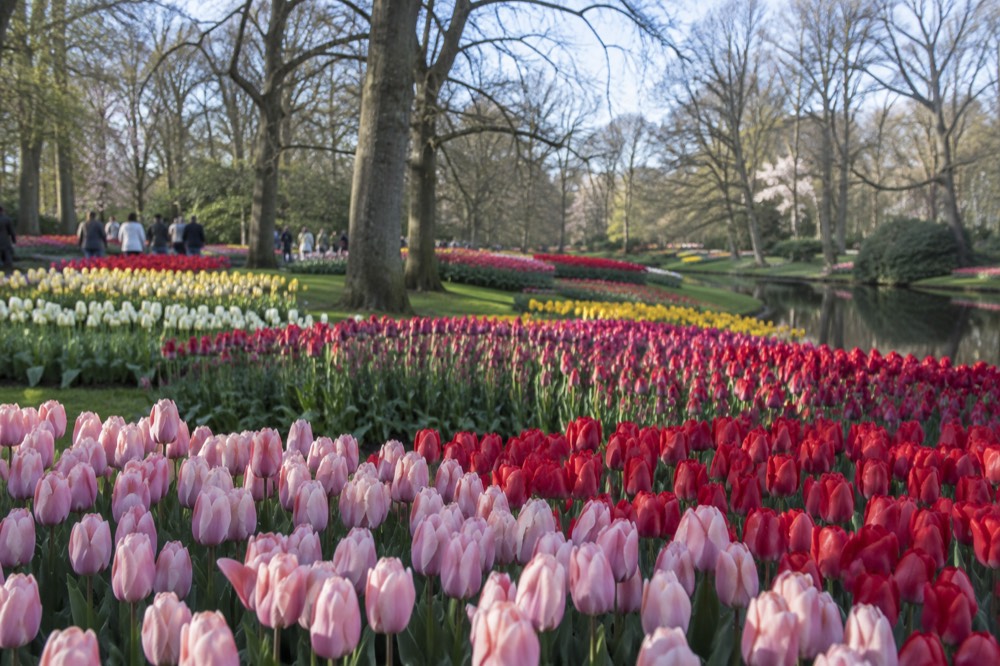
A practical middle path is a combined day trip. The Keukenhof and Zaanse Schans guided tour runs about nine hours and pairs the garden with the windmill village to the north of Amsterdam, which suits visitors who want the two classic Dutch images in one booked, transported day. It is seasonal in the strictest sense: the product only operates while Keukenhof is open, and no operator sells it outside that window. You can check current dates and pricing on Check availability, or read our Keukenhof guide for the independent route.
If you would rather go independent, Keukenhof sells timed tickets through its own site, and direct buses run from Schiphol and Leiden during the season. Cycling is the other classic option: rental points around Lisse put you on the field roads within minutes, and the official Keukenhof contact page (keukenhof.nl) carries the practical details for each season.
Can You See Tulips Without Leaving Amsterdam?
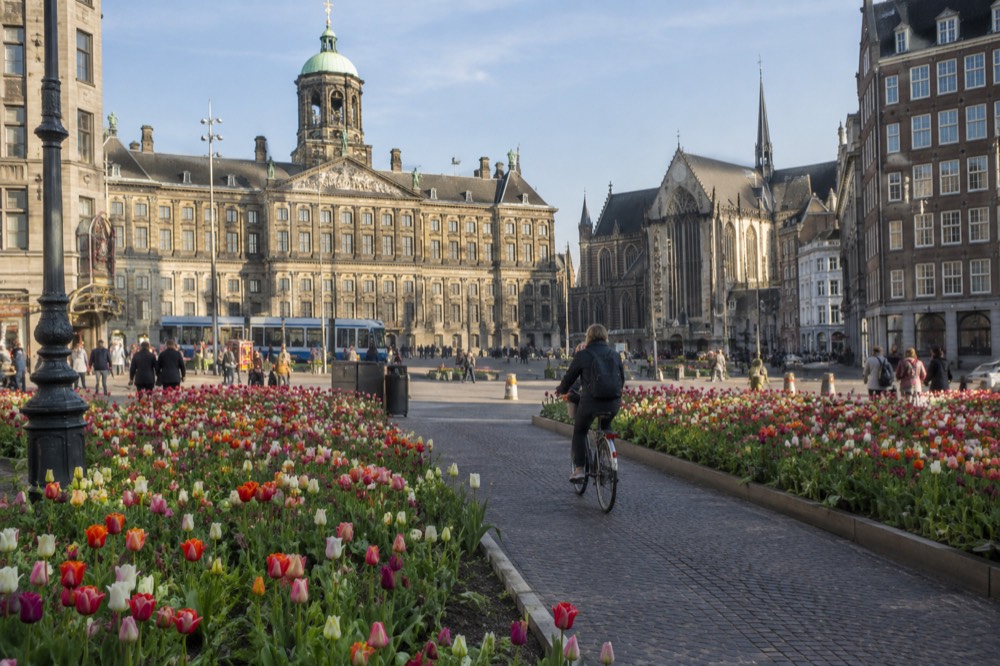
Yes, but only the cultivated version. Amsterdam offers the Bloemenmarkt flower stalls, the tulip beds in the Vondelpark and Museumplein, and two dedicated museums, the Amsterdam Tulip Museum and the flower-filled canvases of the Van Gogh Museum. None of it substitutes for the fields, but on a short layover or a rainy day it is a genuinely good consolation.
The Bloemenmarkt on the Singel is the last of the city's floating flower markets, and while it is touristy at street level it still sells real bulbs, packaged with the paperwork the United States requires. The Vondelpark's tulip beds peak in the same late-April window as the fields, and they are free. The Amsterdam Tulip Museum in the Jordaan tells the story of the 17th-century mania better than most attractions of its size, and the Bloemenmarkt guide on this site covers what is actually worth buying there.
The art route is the sleeper option. The Dutch Golden Age painters made flowers a national subject, and the Van Gogh Museum holds the canvases most people picture when they think of flowers and Holland: the sunflowers, the almond blossom, the irises. A timed ticket from $31, rated 4.7 across more than 57,000 reviews on the live listing, gets you in past a queue that in spring can wrap around Museumplein. Pre-booking is mandatory for everyone, so a walk-up visit is not an option even in theory. The rest of the planning pages sit on Things to Do in Amsterdam.
The honest framing for a city-only day: you will see tulips, and you will enjoy them, but you will not see the fields. If the striped horizon is the reason you are travelling in April, budget the half day it takes to reach the Bollenstreek. It is the single most reliable day trip from Amsterdam in spring, and the transport is simple enough that a tour is a convenience, not a necessity.
What Are the Rules for Walking in the Tulip Fields?
The fields are private commercial farmland, not a park. You may stand at the edge, photograph from the path and the roadside, but you may not walk between the rows, pick flowers or trample the soil, and growers will ask you to leave if you do. The widely repeated etiquette is simple: stay on the path, keep to the edge, and never step into the field itself.
Every spring the local municipalities and growers' associations repeat the same message, because every spring someone wades into the rows for a photo and damages a crop that is someone's livelihood. A tulip field in bloom looks like a public spectacle, but it is the agricultural equivalent of a factory floor two weeks before delivery. The flower heads are cut off within days of peak bloom anyway, so a broken stem is not just a picked flower, it is a lost bulb.
Photography is welcome from the outside. The best pictures of the fields are almost all taken from the field edges, the bike paths and the small bridges over the drainage ditches, and those vantage points are public. Drones are a separate question: rules over built-up areas and nature reserves in the Netherlands are strict, and the dune reserves that border parts of the Bollenstreek are protected. If a drone photo is the goal, check the current rules rather than assuming.
One more nuance worth knowing: some farms have opened paid "selfie fields" or show gardens, planted specifically for visitors, where walking between the rows is the whole point. These are legitimate and clearly signed. The confusion arises when visitors assume every striped field is one of these. If there is no ticket booth and no sign inviting you in, it is a working field and the edge is as far as you go.
How Do You Get to the Bollenstreek From Amsterdam?
The fastest public transport route is the train from Amsterdam Centraal or Zuid to Leiden or Sassenheim, then the seasonal Keukenhof shuttle bus from Leiden station; total journey time is roughly an hour to an hour and a quarter. By car it is 30 to 40 minutes to Lisse depending on traffic, and in late April that traffic is substantial. Cycling from Haarlem through the fields is the scenic option for anyone with a full day.
The seasonal buses are the part that changes every year. During the Keukenhof season, shuttle buses run from Schiphol and Leiden Centraal direct to the garden's gate, at high frequency on busy days, and the operators publish the schedule each spring. Outside the garden's season the shuttles do not exist, which is worth knowing because the fields bloom on the farmers' calendar, not the garden's, and in early May you can still find colour after the buses stop.
For a car-free day built around the fields rather than the garden, the practical plan is train to Hillegom or Lisse, bike rental near the station, and a loop through the field roads. For a car-free day built around certainty, the guided day tours that combine Keukenhof with windmills or a village solve the transport, the timing and the ticket in one booking. The trade-off is schedule: you visit on the operator's clock, in a group, and you will not linger on a quiet field road because a guide has a bus to catch.
| Option | Journey Time | Best For | Watch Out For |
|---|---|---|---|
| Train to Leiden plus seasonal shuttle | About 1 hour to 1 hour 15 | Garden-focused days | Shuttles only run in Keukenhof season |
| Car to Lisse | 30 to 40 minutes | Flexibility, field hopping | Severe late-April traffic and parking queues |
| Train plus bike rental | About 1 hour plus riding | The open fields at your own pace | Needs a full day and decent weather |
| Guided day tour | Booked itinerary, about 9 hours for a combined day | Certainty, no planning | Fixed schedule, group pace |
Whatever route you pick, go early. The fields are at their best in morning light and the roads are at their worst from late morning onward. An 08:00 start from Amsterdam puts you among the rows before the coaches arrive, and the same trip started at noon costs you an hour in traffic for identical flowers.
The tulip window is short, agricultural and unapologetic about both. Plan around the growers' calendar rather than the school holidays, get to the Bollenstreek rather than searching inside the city, and late April will do the rest. If the dates do not cooperate, Keukenhof's engineered eight-week season and Amsterdam's flower markets and museums are the fallback, and they are a better fallback than almost any city in Europe offers.
Common Questions About the Tulip Fields Near Amsterdam
Where Is The Best Place To See The Tulip Fields?
The Bollenstreek, the bulb-growing strip between Haarlem and Leiden, with Lisse as the anchor village and Keukenhof inside it. It sits roughly 30 to 40 minutes from Amsterdam, and any road through the strip in late April will cross flowering fields.
When is the best time to see the tulip fields near Amsterdam?
Roughly mid-April to early May for the open fields, which is later than most visitors expect. Keukenhof runs 18 March to 9 May 2027 and has colour across that whole window, but the farm fields peak only in the last two weeks of April and the first days of May.
Can you see tulip fields inside Amsterdam itself?
No true commercial fields. The city offers tulip beds in the Vondelpark and Museumplein, the Bloemenmarkt flower market and the Amsterdam Tulip Museum, plus flower-themed painting in the Van Gogh Museum and the Rijksmuseum, but the striped fields are all outside the city.
Is Keukenhof worth it if the open fields are free?
They serve different purposes. Keukenhof guarantees colour across its full season with about seven million planted bulbs, while the free fields are spectacular only at peak and can be topped within days. Visit in early or mid-April and Keukenhof is the safer bet; in late April the fields are the main event.
Can you walk between the tulip rows?
Not in commercial fields. They are private farmland, and the rule is to stay on paths and field edges, photograph from outside and pick nothing. Some farms run paid show fields where walking in is the point, and those are clearly signed and ticketed.
How do you get to the tulip fields without a car?
Train from Amsterdam to Leiden or Sassenheim, then the seasonal Keukenhof shuttle bus, or train to Hillegom or Lisse plus bike rental for a field loop. Guided day tours from Amsterdam handle transport and garden tickets in one booking during the season.