Tulip Fields Near Amsterdam: Lisse and the Bollenstreek Day Trip
The tulip fields sit not in Amsterdam but in the Bollenstreek, the bulb-growing strip that runs southwest of the city, with Lisse as its best-known base and Keukenhof as its eight-week centrepiece. Here is how the season works, when to come, and how to get there.
Short answer
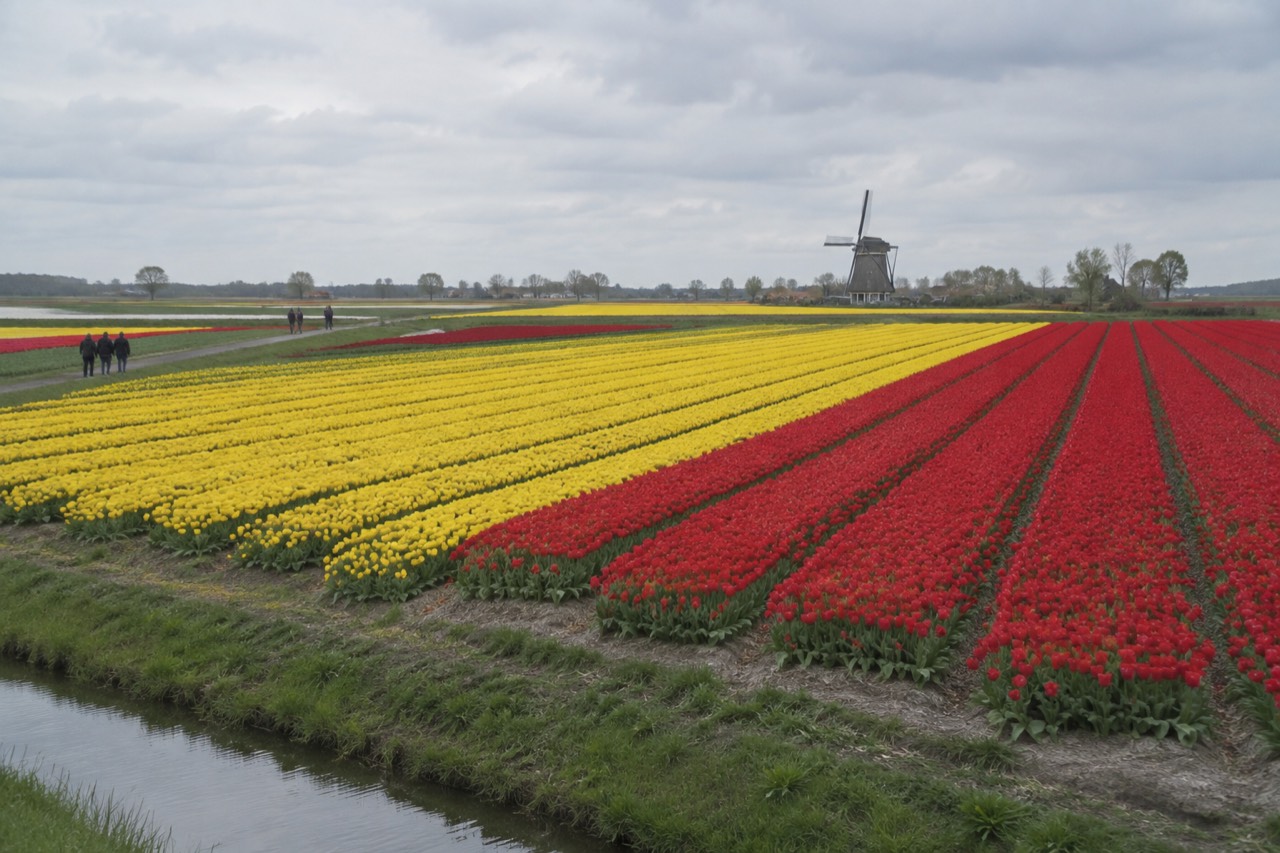
The tulip fields around Amsterdam bloom from mid-March to mid-May, with the field peak roughly mid-April to early May. Keukenhof, in Lisse about 30 to 40 minutes from Amsterdam, opens 18 March to 9 May 2027, daily 08:00 to 19:00. Book timed tickets online ahead; the season is short and weather-dependent.
The most common mistake travellers make about the tulip fields is assuming they are a permanent feature of the landscape, something you can see on any weekend from April to September. They are not. The fields are working farmland, planted in autumn, stripped after the bloom, and the whole spectacle runs for a matter of weeks. Amsterdam itself has almost none of it: the bulb fields begin southwest of the city, in the sandy strip between Haarlem and Leiden that the Dutch call the Bollenstreek, the bulb region, with the village of Lisse at its heart.
This guide covers the season, the geography, the transport and the tour options, plus what to do if your trip lands outside the eight-week window. Everything date-specific here comes from the operators' own pages and the official Keukenhof site, and the tour prices come from live listings we track on Things to Do in Amsterdam.
When Can You Actually See Tulip Fields in Bloom?
The honest answer is a narrow window: the wider season runs roughly mid-March to mid-May, and the fields themselves peak around mid-April to early May. Keukenhof, the region's flagship garden, opens 18 March and closes 9 May in 2027, daily 08:00 to 19:00. No official body publishes a guaranteed peak week, because the bloom is weather-dependent and shifts every year.
That last point deserves emphasis because almost every article on this topic quietly fudges it. There is no KNMI-style official bloom forecast, no meteorological definition of "peak tulip". The only hard anchors are the Keukenhof season dates, published on the garden's own site, and the broad field window that growers and regional sources describe. If a guide promises you "the best week", it is guessing. Plan for late March if you want early colour and smaller crowds, or mid-April if you want the fields at their most saturated.
The garden and the fields are also different experiences. Keukenhof is a designed park: seven million bulbs arranged in beds, themes and rivers of colour, all guaranteed to look good because the planting is staggered across the whole season. The open fields are agriculture: commercial growers raising bulbs, with stripes of a single variety running to the horizon. The fields are more photogenic and more fragile, and they are at their best for a shorter period than the garden.
| Period | What you see | Best for |
|---|---|---|
| Late March | Early tulips, crocuses and daffodils; fields mostly green | Keukenhof without the biggest crowds |
| Early April | Daffodils and hyacinths at peak, first tulip rows opening | Colour with thinner queues |
| Mid-April to early May | Tulip fields at their most saturated | The postcard photos |
| After 9 May 2027 | Keukenhof closed, fields being topped and harvested | Not the tulips; see the alternatives below |
One planning note that follows from all this: build slack into your itinerary. If you are in Amsterdam for four days in mid-April, you have room to pick the clearest of those days for the fields. If you are there for a weekend in early May, you are gambling on the tail of the season, and the fields may already be topped.
Where Exactly Are the Tulip Fields Near Amsterdam?
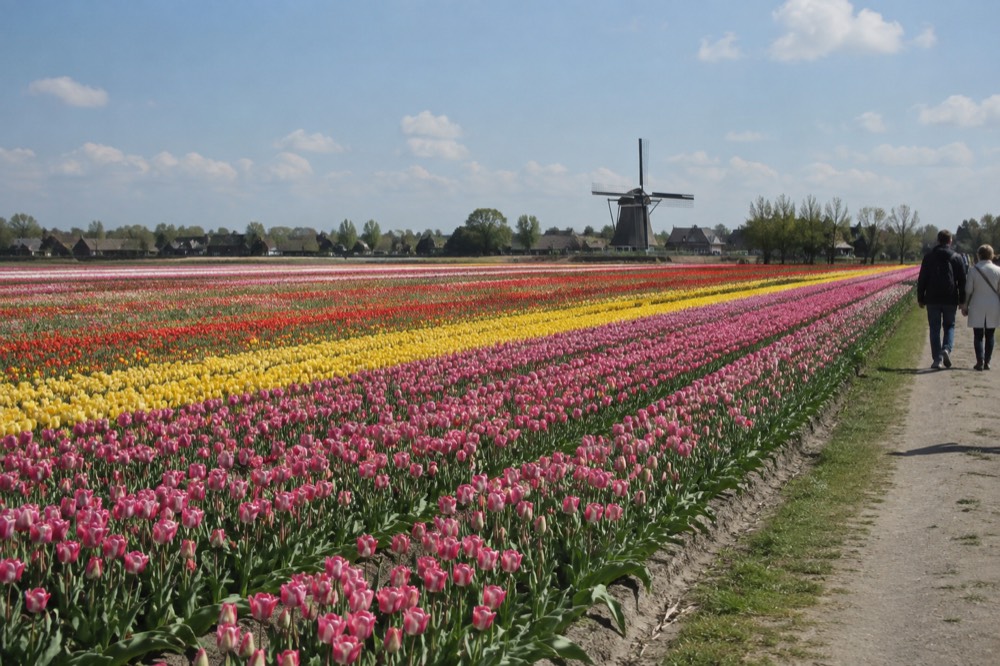
They are in the Bollenstreek, the bulb-growing strip between Haarlem and Leiden, roughly 30 to 40 minutes southwest of Amsterdam by road. Lisse is the central village of the region and the home of Keukenhof. The fields fan out around Lisse, Noordwijk, Sassenheim and Hillegom, and the whole area is flat, sandy and criss-crossed by bike paths and farm lanes.
The name matters for planning. "Bollenstreek" literally means bulb strip, and it exists because of the soil: the coastal dune belt has a light sandy ground that drains fast and suits bulb growing, and the growers have worked it for centuries. Amsterdam's clay and its dense city fabric are wrong for both, which is why the fields are not in the city and never were.
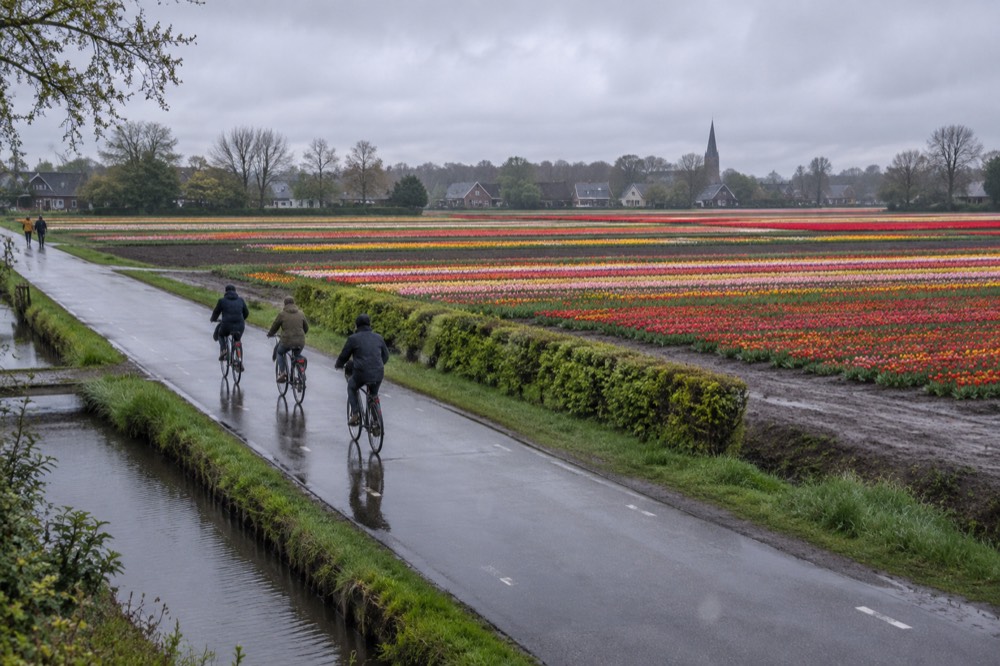
For a visitor, the practical geography is simple. Everything clusters within a short drive of Lisse. Keukenhof sits on the village edge, and the commercial fields surround it in every direction, thickest between Lisse and Noordwijk toward the coast. If you come by tour bus, you will be delivered to Keukenhof and, on the better tours, driven slowly through the field roads with photo stops. If you come independently, Lisse is the base: park once, and either walk to Keukenhof or rent a bike locally and ride the field lanes.
The region rewards a slow afternoon. The lanes between the fields are quiet, the villages are small and pleasant, and the light on a clear April evening, low and warm across flat land, is what photographers come for. Our Amsterdam in spring and tulip season guide covers how the season fits into a wider city itinerary, and the Keukenhof guide goes deep on the garden itself.
If you are weighing a self-drive, be aware that the field roads are narrow, the parking around Keukenhof is managed and priced, and on peak weekends the whole village jams. Most first-time visitors are better served by either a guided day tour or a combination of Keukenhof plus a bike rental on the spot.
How Do You Get from Amsterdam to the Tulip Fields?
The realistic options are a guided day tour with transport included, a Keukenhof combi-ticket bus direct from Amsterdam, or a self-guided trip by train toward Haarlem or Leiden plus a local bus or bike. Lisse is roughly 30 to 40 minutes from Amsterdam by road. In the season, book any option ahead: Keukenhof uses timed entry, and the official site states that a start time must be reserved online.
The guided tour is the default for good reason. It removes three decisions at once: the transport, the timed-entry booking and the route through the fields. The strongest season-specific product on our roster is the Keukenhof and Zaanse Schans day tour, which pairs the garden with the windmills of the Zaan region in a single nine-hour day, rated 4.6 across 1,337 reviews and priced from $107. For a full read on that option, see the tour page on this site, or Check availability for live dates and pricing. The official season details are on Keukenhof's own site.
Going independently works well if you want flexibility more than commentary. The pattern most locals use is a train to Haarlem or Leiden, both quick regional hops, and then a bus toward Lisse, or a bike from the Keukenhof area itself. The trade-off is timing: buses in the season run full, the last returns are earlier than you expect, and if the weather turns you are standing in a field with a long way back.
Whichever way you travel, go early. The garden opens at 08:00 in the 2027 season and the first two hours are the calmest of the day; by late morning the coach groups arrive in waves, and by afternoon the photo spots at the windmill and the tulip river carry queues.
| Way to visit | Best for | Trade-off |
|---|---|---|
| Guided day tour from Amsterdam | First-timers, anyone without a car, photo stops in the fields | Fixed schedule, less time in the village |
| Combi-ticket bus to Keukenhof | Budget day out, garden only | No field stops; check the operator's own listing for what is included |
| Train plus local bus or bike | Independent travellers, flexible days | Season crowds on local buses; plan the return leg |
| Rental car | Photographers chasing evening light | Narrow lanes, managed parking around Lisse |
Keukenhof or the Open Fields: Which Should You Choose?
Choose Keukenhof for a guaranteed, designed spectacle across the whole eight-week season; choose the open fields for the wide, striped landscapes you have seen in photographs, but only inside the narrower mid-April to early May peak. The best days combine both: the garden in the morning, the field lanes by bike in the afternoon, and the two are within easy reach of each other around Lisse.
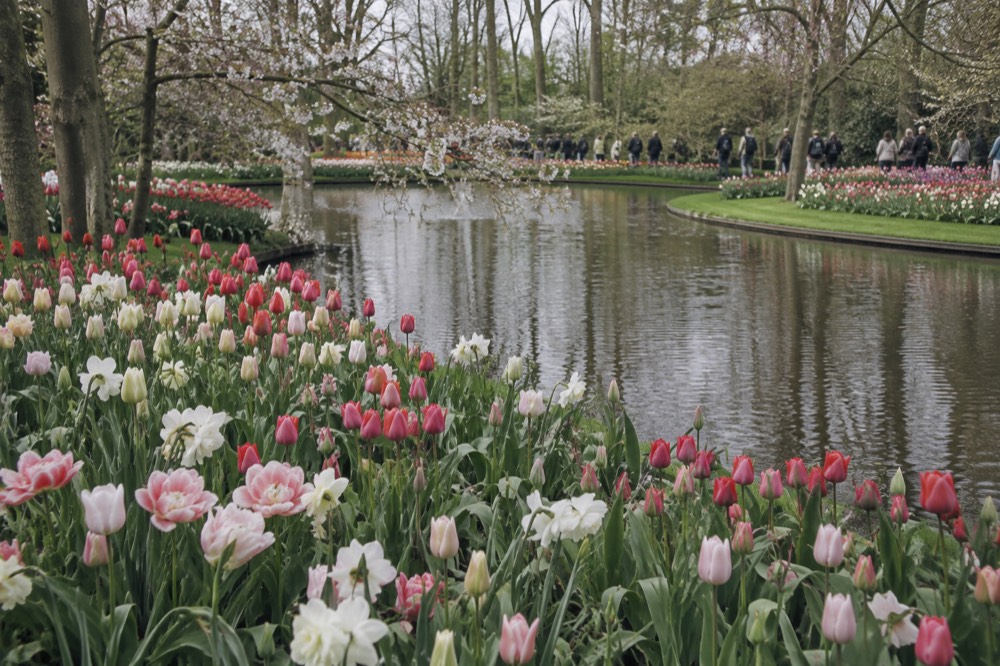
Keukenhof is the safe half of the bet. Because its planting is staggered, the garden looks full from the 18 March opening to the 9 May close, and the official site confirms those 2027 dates, daily 08:00 to 19:00. It is not subtle: seven million bulbs, themed sections, a windmill, a tulip river. It is also genuinely good, and it is the only part of the region that performs on schedule regardless of the spring weather.
The open fields are the risky half, and the reward. A commercial tulip field in full bloom, one variety per stripe running to a treeline, is a different order of sight from any garden bed. But the fields are agriculture on a schedule: growers top the flowers when the bloom passes its prime to push energy back into the bulbs, and a warm spring can pull the whole calendar forward by a week or more. If your trip is fixed for early May, the fields may be past it while Keukenhof still looks immaculate.
A practical note on the fields themselves: they are private farmland, not a park. The tour products that stop at fields do so at spots the operators have arranged, and the independent way to see them safely is from the public lanes and bike paths that run between them. Photographers should treat the crop rows as off-limits, which the region's own signage makes plain.
Which Guided Day Tours Are Worth Booking?
The best tulip-season tours from Amsterdam are the ones that bundle the garden with either the windmills or a second region, because a Keukenhof-only day leaves you with a half-empty afternoon. On our roster the strongest fit is the Keukenhof and Zaanse Schans day tour, from $107, rated 4.6 across 1,337 reviews, nine hours. In spring only, it is the season's signature product.
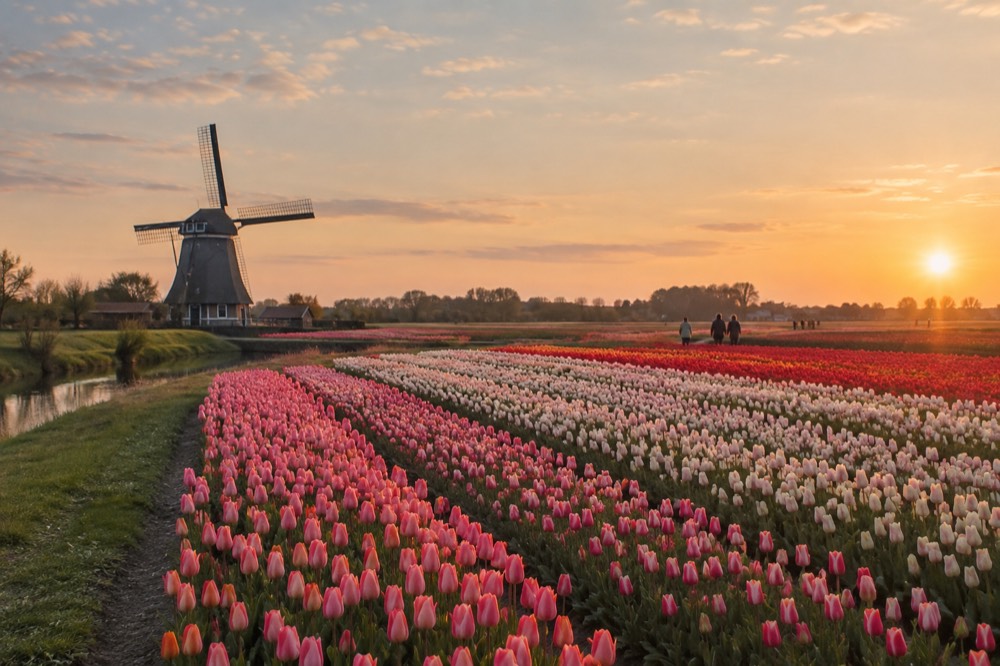
The logic of the pairing is simple. Keukenhof fills a morning beautifully, but the garden itself is a half-day experience, and Lisse has little else to fill the rest. The Zaanse Schans windmills, an hour north of Amsterdam, add the other half of the Dutch postcard: green wooden houses, working mills, the industrial landscape of the seventeenth century. Our Zaanse Schans guide covers what that stop involves, and the tour listing carries the live departure dates.
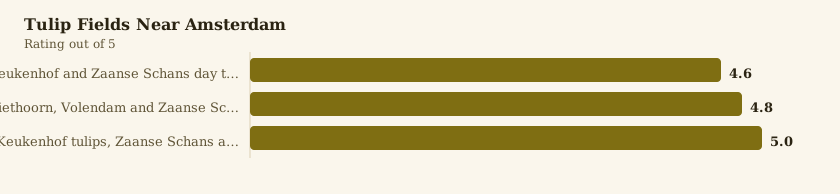
If your dates fall outside the Keukenhof window, or the garden's timed tickets have sold out on your day, the wider day-trip roster still delivers. The Giethoorn, Volendam and Zaanse Schans tour is the big full-day option, ten hours, from $161, rated 4.8 across 812 reviews, and it threads the car-free village of Giethoorn together with the fishing villages and windmills. It has no tulips, but it has everything else the spring photographs promise.
| Tour | Duration | Rating | From (per person) |
|---|---|---|---|
| Keukenhof and Zaanse Schans day tour | 9 hours | 4.6 (1,337 reviews) | $107 |
| Giethoorn, Volendam and Zaanse Schans tour | 10 hours | 4.8 (812 reviews) | $161 |
| Keukenhof tulips, Zaanse Schans and cheese tour | 9 hours | 5.0 (3 reviews) | $198 |
A word on the third row: the Keukenhof tulips, Zaanse Schans and cheese workshop tour is a small-group, workshop-heavy variant at the top of the price range, and its review base is still tiny at three reviews. Treat the 5.0 rating as thin evidence rather than a verdict, and read the listing's own itinerary before paying the premium. Every tour above runs only inside the Keukenhof season or, for the non-tulip options, on a normal schedule; check the live listing for the dates that actually match your trip.
What If You Miss Tulip Season?
If your trip falls outside mid-March to mid-May, the fields are gone until next spring, but Amsterdam keeps the tulips indoors. The Van Gogh Museum holds the flower paintings, including his tulip-period works, and its own site confirms it is open daily 9am to 6pm, Fridays until 9pm, with timed entry required for every visitor. The floating Bloemenmarkt sells cut stems and bulbs year-round.
The Van Gogh option is the one people underrate. The museum's collection covers the flower still lifes that made the tulip a painter's subject, and at $31 from the listing, rated 4.7 across 57,096 reviews, it is a reliable half-day that has nothing to do with the weather or the calendar. The museum's own plan-your-visit page states the booking rule plainly: all visitors need a pre-booked timed entry ticket, and slots sell out.
The Bloemenmarkt, the floating flower market on the Singel, is the second stop for an out-of-season fix. It trades in cut flowers, bulbs and souvenirs on the water year-round, and our Bloemenmarkt guide explains what is actually worth buying there. If you are bringing bulbs home, the export rules matter more than the price, and the market's vendors handle the certification.
For the rest of the year, the honest framing is this: the tulip fields are a spring event, not an Amsterdam attraction. Come in June and you get the roses and the long evenings; come in October and you get the museums, the brown cafés and the first of the light festival season. Our best time to visit Amsterdam guide lays out the trade-offs month by month, and it does not pretend April has a monopoly on the city.
How Do You Plan a Tulip Day That Does Not Go Wrong?
Book Keukenhof timed entry online before you leave home, pick a weekday if your dates allow, arrive at opening time, and hold a backup plan for weather. Do not build the fields into your last day in Amsterdam, because a washed-out morning then costs you the whole experience, and never trust a fixed peak-bloom date from any source, because no official forecast exists.
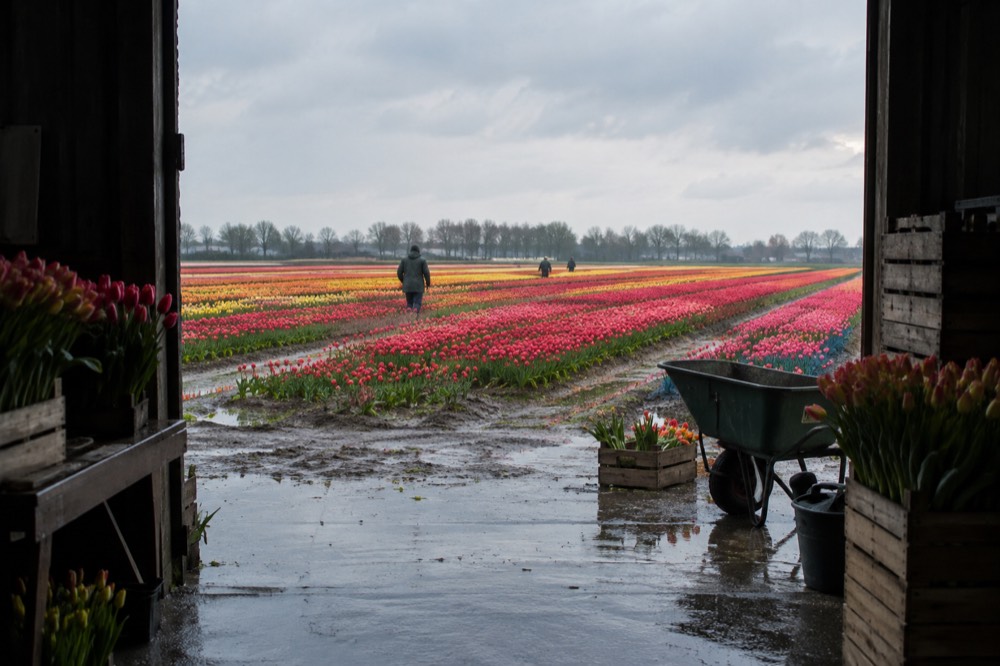
The booking rule comes from the garden itself: timed entry with a reserved start time, and tickets in limited supply at the gate. In practice that means the peak weekends of mid-April sell their morning slots first, and a traveller who arrives hoping to buy at 11:00 on a Saturday can be turned away or pushed to late afternoon. Booking a tour with entry included removes that risk entirely, which is part of what the premium buys.
Weather deserves a line of respect. The Bollenstreek is open flat land, and an April day there swings between t-shirt warmth and horizontal rain, sometimes inside one afternoon. The fields photograph badly in flat grey light and beautifully in the low sun of early morning or late evening, so if you have any flexibility, keep the field portion of your day at one edge of it. Keukenhof, being a garden with greenhouses and cafés, absorbs a bad hour far better than an open field does.
Finally, keep the day realistic. Lisse is close, but a Keukenhof morning, a field-lane afternoon and a return to Amsterdam in time for an evening canal cruise is a full day, not a half. The classic saloon boat cruise in the trio above, one hour on a restored nineteenth-century boat from $19.56, rated 4.8 across 33,435 reviews, is the natural way to end it: feet up, city from the water, tulips photographed and the legs finished.
Common Questions About the Tulip Fields Near Amsterdam
When is tulip season in Amsterdam?
The wider season runs roughly mid-March to mid-May, anchored by Keukenhof's own dates: 18 March to 9 May in 2027, daily 08:00 to 19:00. The open fields peak around mid-April to early May, and the exact week shifts with the weather every year.
Can you see tulip fields inside Amsterdam?
No. The commercial bulb fields are in the Bollenstreek, the sandy growing region between Haarlem and Leiden, with Lisse at its centre, roughly 30 to 40 minutes from Amsterdam by road. In the city, the seasonal colour is in parks, the Bloemenmarkt and Keukenhof-adjacent displays.
Is Keukenhof worth it if the fields are not at peak?
Usually yes. Keukenhof's planting is staggered across the whole eight-week season, so the garden performs from opening day to closing day, while the open fields hold their peak for a much shorter period. If your dates are late March or early May, the garden is the safer bet.
How much does a tulip day trip from Amsterdam cost?
Entry to Keukenhof is bought separately from transport, and 2027 garden prices were not yet published at the time of our research. Guided day tours from Amsterdam that include the garden start at $107 on our roster for the nine-hour Keukenhof and Zaanse Schans combination.
Can you walk in the tulip fields?
The fields are private commercial farmland, not public parkland. See them from the public lanes and bike paths that run between them, or on a tour with arranged photo stops. Treat the crop rows themselves as off-limits.